what three conditions need to be met for an experiment to have internal validity?
Internal Validity | Definition, Threats and Examples
Internal validity is the extent to which you can be confident that a cause-and-effect relationship established in a study cannot be explained by other factors.
In other words, can you lot reasonably draw a causal link betwixt your treatment and the response in an experiment?
Why internal validity matters
Internal validity makes the conclusions of a causal relationship credible and trustworthy. Without loftier internal validity, an experiment cannot demonstrate a causal link between two variables.
In one case they arrive at the laboratory, the treatment group participants are given a cup of coffee to drink, while control group participants are given water. You too requite both groups retentivity tests. After analyzing the results, you lot find that the treatment group performed better than the command group on the memory test.
Tin y'all conclude that drinking a cup of java improves memory performance?
For your conclusion to be valid, you need to be able to rule out other explanations for the results.
How to check whether your report has internal validity
There are three necessary atmospheric condition for internal validity. All three conditions must occur to experimentally found causality between an contained variable A (your treatment variable) and dependent variable B (your response variable).
- Your treatment and response variables change together.
- Your treatment precedes changes in your response variables
- No confounding or inapplicable factors can explain the results of your study.
In the research instance above, merely two out of the iii weather condition have been met.
- Drinking coffee and retention performance increased together.
- Drinking java happened earlier the memory examination.
- The time of solar day of the sessions is an extraneous cistron that can as explicate the results of the study.
Because you assigned participants to groups based on the schedule, the groups were different at the beginning of the study. Any differences in memory performance may be due to a departure in the fourth dimension of day. Therefore, yous cannot say for certain whether the fourth dimension of day or drinking a cup of coffee improved memory performance.
That means your study has low internal validity, and you cannot deduce a causal relationship betwixt drinking coffee and memory performance.
What can proofreading practice for your paper?
Scribbr editors not only right grammar and spelling mistakes, but also strengthen your writing by making sure your newspaper is gratuitous of vague language, redundant words and awkward phrasing.
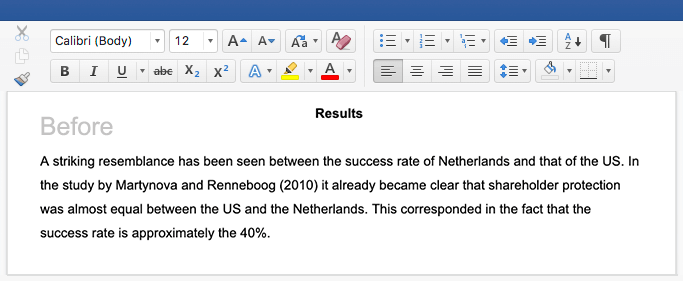
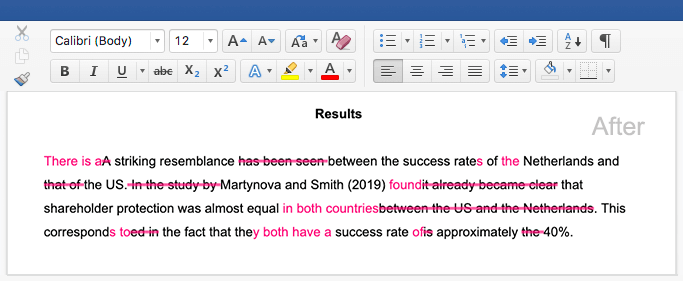
See editing example
Trade-off between internal and external validity
External validity is the extent to which you can generalize the findings of a study to other measures, settings or groups. In other words, can you utilise the findings of your written report to a broader context?
There is an inherent trade-off between internal and external validity; the more than you control inapplicable factors in your study, the less y'all can generalize your findings to a broader context.
Threats to internal validity and how to counter them
Threats to internal validity are important to recognize and counter in a research design for a robust study. Different threats can utilize to unmarried-group and multi-group studies.
Single-grouping studies
| Threat | Significant | Example |
|---|---|---|
| History | An unrelated event influences the outcomes. | A week before the end of the study, all employees are told that there will be layoffs. The participants are stressed on the appointment of the post-test, and performance may suffer. |
| Maturation | The outcomes of the written report vary as a natural result of time. | About participants are new to the job at the time of the pre-test. A month later on, their productivity has improved equally a result of fourth dimension spent working in the position. |
| Instrumentation | Different measures are used in pre-test and postal service-exam phases. | In the pre-test, productivity was measured for xv minutes, while the post-test was over xxx minutes long. |
| Testing | The pre-test influences the outcomes of the postal service-test. | Participants showed college productivity at the end of the study because the same test was administered. Due to familiarity, or sensation of the written report'due south purpose, many participants achieved loftier results. |
How to counter threats in unmarried-group studies
Altering the experimental blueprint can counter several threats to internal validity in single-grouping studies.
- Calculation a comparable control group counters all threats to single-grouping studies. If comparable control and treatment groups each face the aforementioned threats, the outcomes of the study won't be affected by them.
- A big sample size counters testing, considering results would be more sensitive to whatsoever variability in the outcomes.
- Using filler-tasks or questionnaires to hide the purpose of study also counters testing threats.
Multi-group studies
| Threat | Meaning | Instance |
|---|---|---|
| Choice bias | Groups are non comparable at the beginning of the study. | Low-scorers were placed in Group A, while high-scorers were placed in Group B. Considering at that place are already systematic differences between the groups at the baseline, any improvements in group scores may exist due to reasons other than the treatment. |
| Regression to the mean | There is a statistical tendency for people who score extremely depression or high on a examination to score closer to the middle the next time. | Because participants are placed into groups based on their initial scores, information technology's hard to say whether the outcomes would exist due to the treatment or statistical norms. |
| Social interaction | Participants from different groups may compare notes and either figure out the aim of the study or feel resentful of others. | Groups B and C may resent Grouping A because of the access to a telephone during course. As such, they could be demoralized and perform poorly. |
| Attrition | Dropout from participants | xx% of participants provided unusable data. Nearly all of them were from Group C. As a result, it's hard to compare the two treatment groups to a control group. |
How to counter threats in multi-group studies
Altering the experimental pattern can counter several threats to internal validity in multi-group studies.
- Random assignment of participants to groups counters pick bias and regression to the mean by making groups comparable at the beginning of the written report.
- Blinding participants to the aim of the study counters the effects of social interaction.
Oftentimes asked questions
Is this article helpful?
You take already voted. Thanks :-) Your vote is saved :-) Processing your vote...
hamiltontiand1952.blogspot.com
Source: https://www.scribbr.com/methodology/internal-validity/
0 Response to "what three conditions need to be met for an experiment to have internal validity?"
Postar um comentário